Case Study:
The Manufacturer's OEE Playbook
Six-day Education Architecture for an industrial SaaS company. 32 opt-ins from 201 visitors in its first ten weeks, with zero ads.
15.9%
3.7 min
$0

The situation
Maintmaster had just relaunched.
I'd helped on the rebrand from positioning and messaging through to the website copy, including on the home, product, use cases and demo pages.
They had acquired OEE Systems and launched Maintmaster OEE, a production monitoring product that plugs straight into their CMMS and their Manufacturing Intelligence layer. The marketing targets were aggressive for the year in the UK.
The CMMS side of the business converted well, helped by years of word of mouth, a strong name in maintenance, and a new site that made it an easy choice.
OEE converted at a fraction of that, for two reasons.
The first was that almost nobody knew Maintmaster had an OEE offering yet.
The second was that the new site gave a visitor a demo button and ungated white papers, and little else. Their existing lead magnets (the Maintenance Manual, the KPI Manual and a few others) hadn't been migrated across yet.
That mattered less than it sounds, because before, people downloaded them and most vanished. A download gets you an email address in exchange for a PDF, and neither side moves anywhere after that.
So instead of rebuilding four separate lead magnets, we built one master opt-in for the OEE side, a single asset that could do the work of all of them.
The plan
The goal was two-fold: converting a larger part of new cold traffic not ready for a demo, and getting their enterprise customers interested in their new offering and understand the value of adding OEE to complete their manufacturing tech stack.
The mechanism was there. They had six OEE use cases, and every one of them had Maintmaster OEE as the answer, which meant the conclusion of the course was true before I wrote a word of it.
So we built a six-day email course, one use case per day. By day six, a reader would know what was standing in their way, what it was costing them, and what fixing it actually takes.
What we built
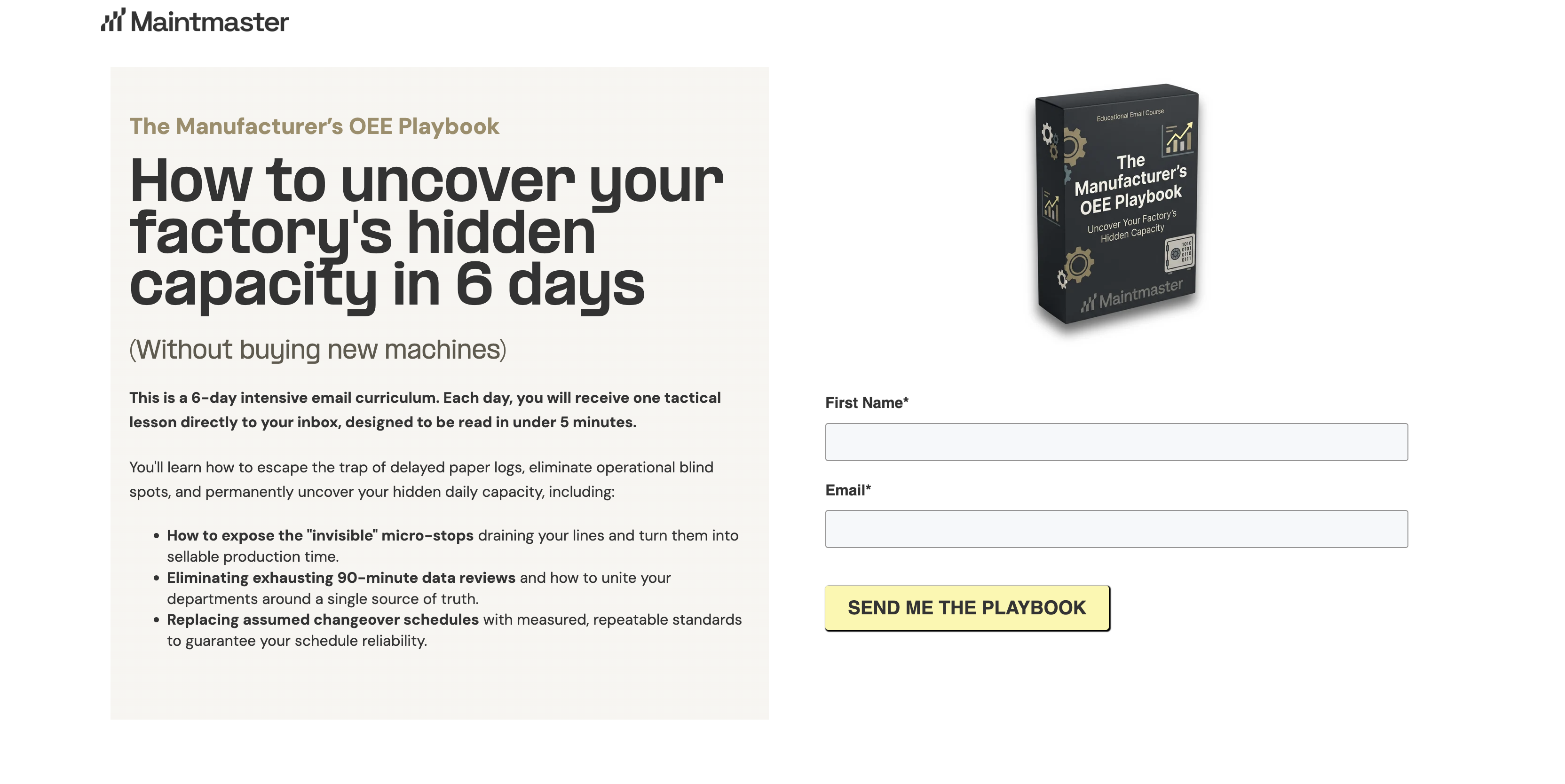
I first drafted the hook, structure and flow.
Robert Brannan, their OEE expert, had final say. He gave me the part I couldn't write myself, which is what actually happens on a shop floor, in the language the people there use.
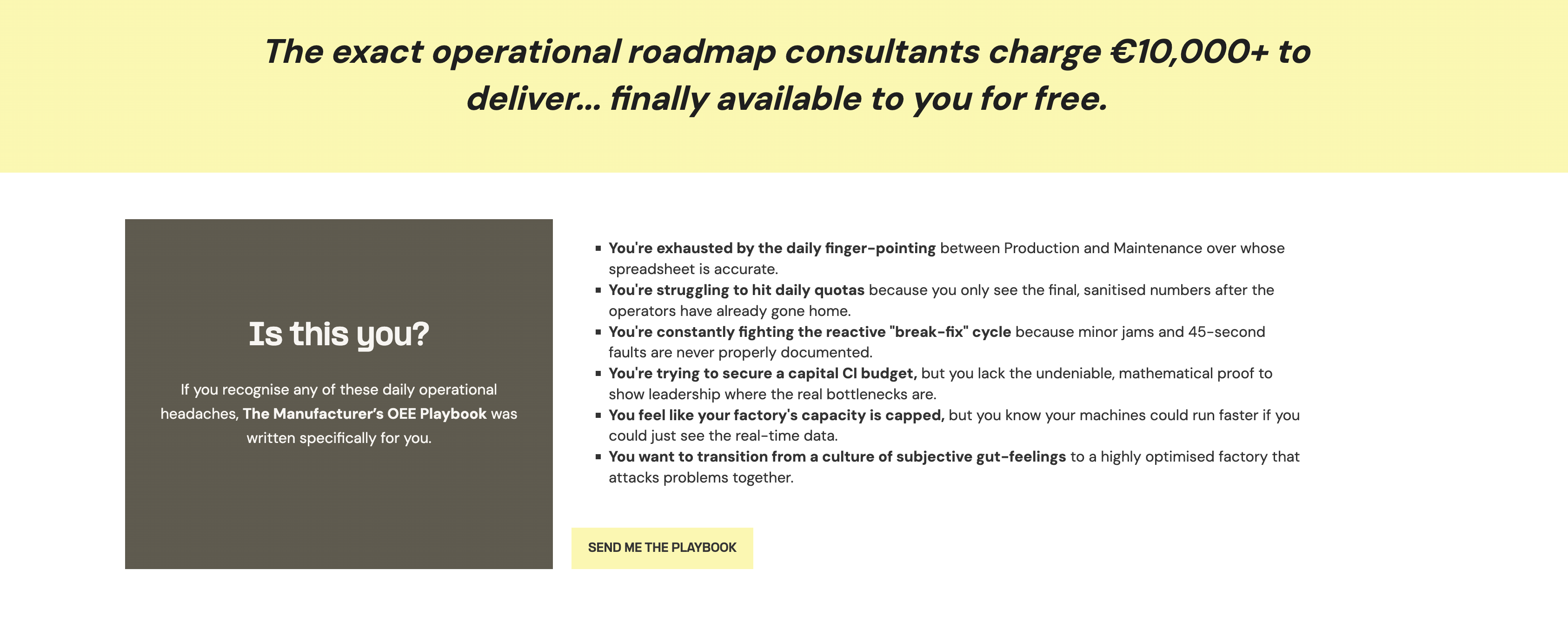
We started out calling them mistakes, and then changed it to traps.
That distinction matters more than it sounds. Nobody on a production floor is making these errors knowingly. They are doing the best they can with the data they have, working around gaps in a system nobody designed. A trap is something you fall into, while a mistake is something you get blamed for, and that difference decides whether the email gets read or deleted.
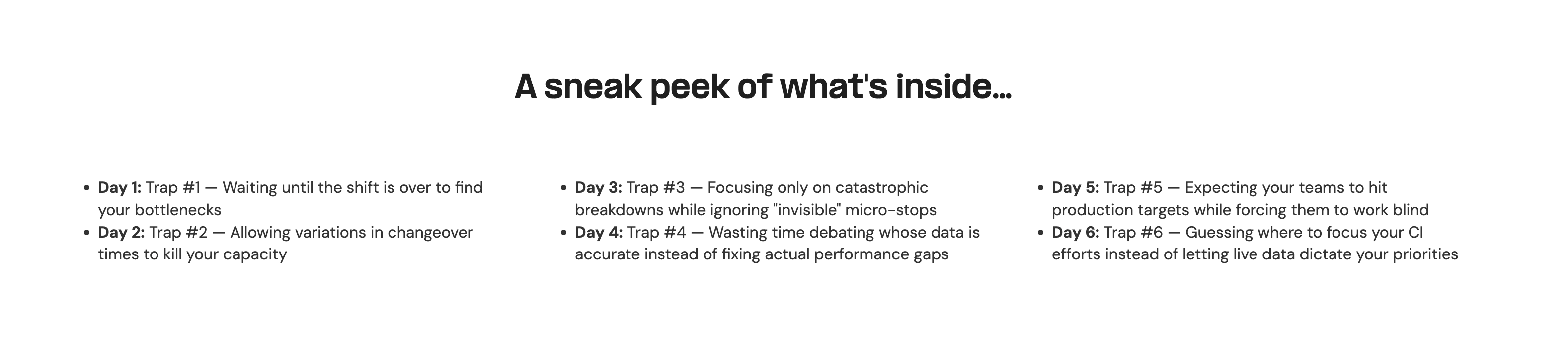
The six traps:
- Waiting until the shift is over to find your bottlenecks
- Allowing variations in changeover times to quietly kill your capacity
- Firefighting equipment failures instead of tracking the early warning signs
- Debating whose data is accurate instead of fixing actual performance gaps
- Expecting teams to hit targets while forcing them to work blind
- Guessing where to focus CI instead of letting live data set the priorities
Irene, along with Thomas, Aaron, and Andrew, their OEE specialist, reviewed the detail before it went live.
Then came the landing page and a sales sequence that runs after day six with a calendar link. Everyone who finishes moves into the OEE newsletter, where they can be segmented by intent.
What happened
The course went live on 12 May, promoted with one LinkedIn post and a sticky banner on the OEE pages, with no ad spend behind it.
In the first ten weeks:
- 201 visitors and 32 opt-ins, which is 15.9%
- 3.7 minutes average time on the page before signing up
- 9 opt-ins from enterprises already running MaintMaster's CMMS
- $0 spent on ads
The opt-in rate is the least interesting number in that list, because who opted in matters more.
Nine of them came from enterprises already running MaintMaster CMMS for maintenance, who were now educating themselves on a production monitoring product they knew little about before.
The rest were manufacturers in aerospace, pharmaceuticals, packaging, HVAC and recycling, several of them employing tens of thousands of people.
After day six, a short sales sequence follows with extra resources and a demo link. Anyone who looks like a fit gets a personal follow-up from an SDR, which is where the course starts producing pipeline.
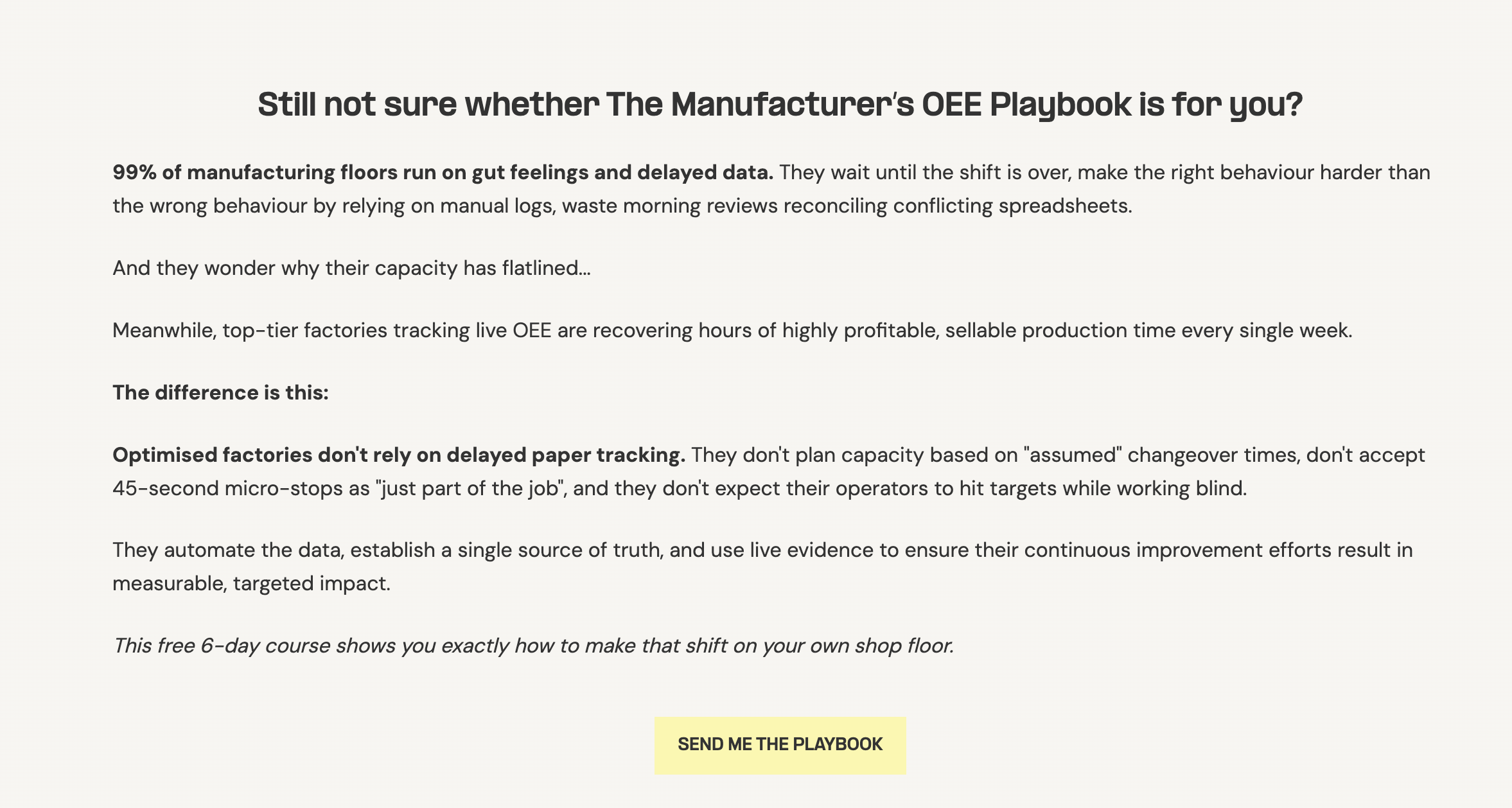
There is one more number worth mentioning, with one caveat. The wider campaign shows around $36,837 of influenced revenue across nine deals.
I would call that influence rather than attribution, because it counts a sitewide banner and a set of forms alongside the course, and some of those deals were already in motion before any of this went live.
The important part is the sequence. Instead of hoping these companies encounter the right ads in the right order, or that LinkedIn's algorithm surfaces the right posts to the right person at the right time, we put the argument in one asset and controlled the order it arrives in. The right information for the right people in the right sequence.
That's Education Architecture.
Why it worked
It was built from existing use cases. Six problems that already had the product as their answer, so the argument held together before it was written.
It used the language of traps. Written for someone doing the best they can with the data they have.
It came from named people. Four experts with photographs, and a reader who could hit reply and get an answer.
It's evergreen. When a new feature ships the copy gets updated, and the asset carries on working. Build once and it delivers forever.
The part worth thinking about
All of that came from 201 visitors.
The B2B SaaS sites I audit are usually doing somewhere between 10,000 and 100,000 visits a month, often with a large chunk of that traffic paid for by expensive ads.
Most of those visitors get the same three choices. Book a demo, subscribe, or download an ebook that sits unopened on a hard drive. Sometimes a nurture sequence follows, arguing five unrelated points on a timer.
Education Architecture changes that.
"Education Architecture was new for us, but Pelle created the concept and assets fast, drawing on our internal experts. Within 10 weeks, with zero ad spend, one LinkedIn post, and a website banner, we got 32 signups (15.9% opt-in rate and growing). Manufacturers with tens of thousands of employees, plus several of our own enterprise customers educating themselves on a product line they didn't know we had. We've now passed 40. Day 6 opens as well as Day 1. The asset just sits there and works for us."
.png)
- Jon Lindholm, Chief Marketing Officer @ Maintmaster
Want to capture the 98% of website visitors who don't book a demo?
Fifteen minutes, live: the Education Architecture for your ICP, including the hook and outline. Yours whether we work together or not.
Turn the 98% who don't book a demo into buyers who do.
.png)